Business Strategy
7 Signs Your Business Has Outgrown Off-the-Shelf Software (SaaS Sprawl Checklist)
A practical diagnostic and checklist for growing companies struggling with SaaS sprawl, shadow spreadsheets, and operational friction.
When central tools force your team into manual workarounds, software becomes a growth bottleneck rather than an operational asset.
You started with one tool for email, one for tasks, and one for accounting. It worked. Then you added three more to close gaps. Now your team spends more time syncing tools than serving customers.
If that sounds familiar, you are not alone. This article gives you a simple diagnostic to tell if you have outgrown off-the-shelf software. We will walk through seven clear signs, share real vignettes from growing teams, and give you a scoring guide to know when it is time for a systems review. We built this at Delta Technologies because we see it every week.
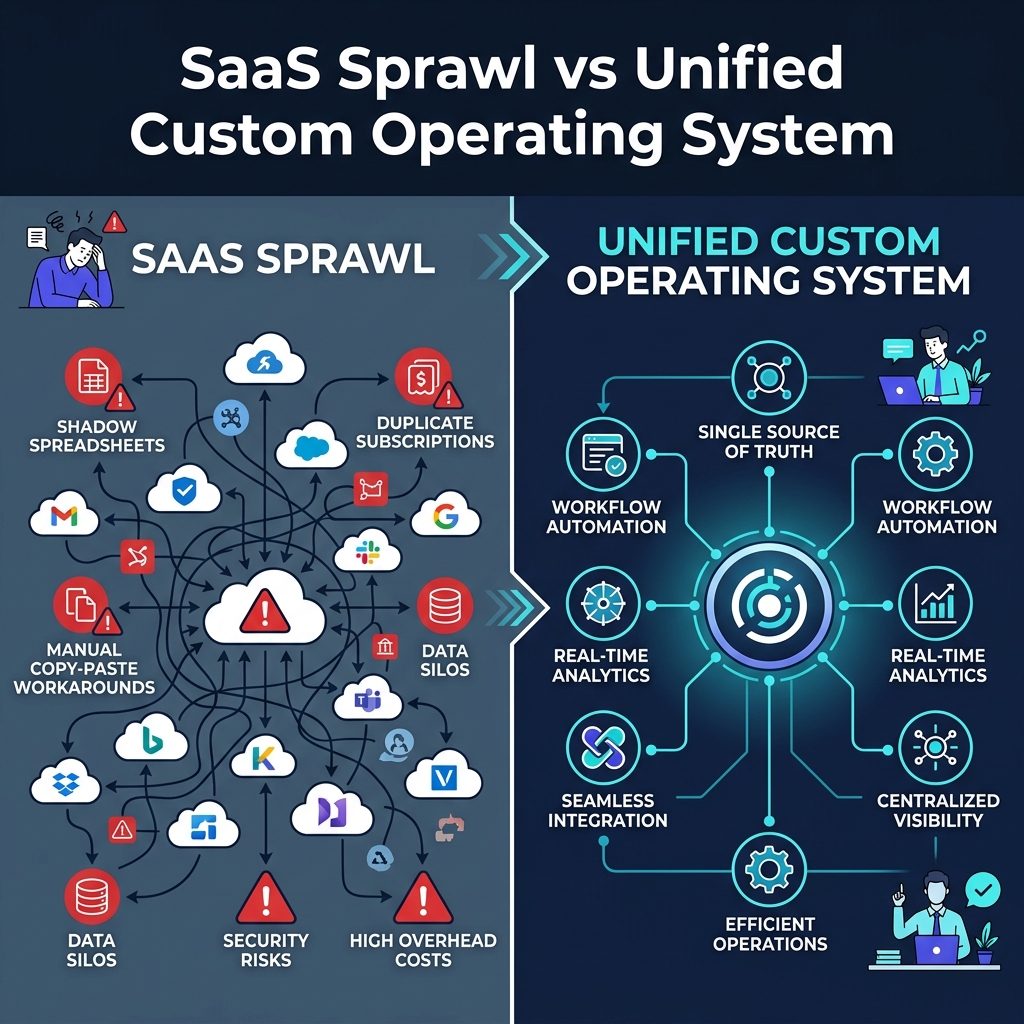
What Is SaaS Sprawl And Why It Hit Growing Companies Hard?
SaaS sprawl is the uncontrolled growth of software as a service apps inside a company without central oversight. Techopedia defines it as the point where admins can no longer manage third-party cloud apps effectively.
For a growing company, that sprawl creates tool fatigue, data fragmentation, and software workaround costs that compound every quarter.
1. Your Critical Work Lives In Spreadsheets
Vignette: A sales ops lead in River North keeps the real forecast in Google Sheets because the CRM cannot handle custom pricing rules. Every Monday she exports, cleans, and reimports. One wrong sort breaks the board report.
This is classic spreadsheet dependency. When your CRM, ERP, or project tool cannot model your actual workflow, people build shadow spreadsheets. Those sheets become mission critical without version control, permissions, or audit trails.
If a spreadsheet is your single source of truth, your SaaS tool is not.
Check for these:
This is one of the clearest signs you need custom software because you are already building it in the wrong place.
2. Data Lives Everywhere And Nowhere At Once
Vignette: A service company near Willis Tower has customer data in four places. Support uses Zendesk, sales uses HubSpot, accounting uses QuickBooks, and ops uses Airtable. No one agrees on lifetime value.
Data fragmentation happens when each tool owns a slice of the customer journey. You lose time reconciling reports. You lose trust in numbers. Your team stops making fast decisions because they have to hunt for facts.
A single source of truth should be a system, not a meeting to reconcile systems.
Ask yourself:
At Delta Technologies, our data platforms work together to connect these islands so your team sees one customer record. Learn more about how we build them in our custom software development services.
3. You Are Paying For Five Tools That Do One Job
Vignette: A 35-person agency pays for Calendly, OnceHub, a forms tool, an e-signature tool, and Zapier to glue it together. The monthly stack costs more than hiring a part-time ops person.
This is SaaS sprawl in action. Tool fatigue sets in when licenses overlap by 60 percent. According to recent industry data, 44 percent of SaaS licenses go unused. That waste adds up, especially when you count the hidden cost of managing renewals, permissions, and onboarding.
If you need a tool to manage your tools, you own too many tools.
Audit this week:
When you have outgrown SaaS, consolidation into one purpose-built flow often costs less over two years than keeping the sprawl.
4. Shadow IT Is Running Your Operations
Vignette: Marketing buys a new AI writing tool on a personal card. Support starts using it for customer replies. No security review, no data policy, no offboarding plan.
Shadow IT is not about bad intent. It is about good people trying to get work done fast. When central tools are slow or rigid, teams adopt their own. The risk is real. Research notes 55 percent of employees adopt SaaS without security team involvement.
Shadow IT is a signal that official tools do not match real workflows.
Signs to watch:
We see this a lot with fast-growing teams around Magnificent Mile who need to move quickly. Our approach is to map those shadow workflows and turn them into secure, approved features inside your own system. See how we automate handoffs in our AI workflow automation.
5. Every Process Needs a Manual Workaround
Vignette: To close a deal, a rep has to create a project in Asana, then copy it to Monday, then ping finance in Slack, then update a sheet. If one step is missed, billing is late.
Software workaround costs are the hours your best people spend doing what software should do. This happens when off-the-shelf tools force you into their process instead of modeling yours. Your team creates glue work.
Workarounds are unpaid labor you give to your software vendor every day.
Count them:
If the answer is more than three per workflow, you have likely outgrown your current stack.
6. You Cannot Customize Without Breaking Something
Vignette: An ops manager wants to add a required field for regulatory compliance. The SaaS admin says it will break five automations and two reports, so they skip it and track compliance in email.
Off-the-shelf platforms lock customization behind complex permissions or hard limits. You either accept their way or risk breaking downstream flows. Growing companies need to adapt fast, especially in regulated industries like healthcare and finance.
If customization feels risky, your platform is too fragile for your stage.
Test this:
When these answers are no, that is a clear sign you need custom software that is built to change.
7. Your Team Has Stopped Trusting the System
Vignette: A founder asks for a pipeline by product line. Two dashboards show two different numbers. The team spends the meeting debating data, not decisions.
Trust is the last thing to go. When tool fatigue and data fragmentation pile up, people stop believing the system. They build side systems. They ask for data in chat instead of dashboards. Leadership flies blind. Low trust in tools leads to low speed in decisions.
Listen for:
If you hear these weekly, you have outgrown off-the-shelf software.
How To Score Your SaaS Sprawl Checklist
Use this simple scoring guide. Be honest. Give one point for each sign that is true for your company right now.
| Score | What It Means | What To Do Next |
|---|---|---|
| 0 to 1 | Healthy sprawl | Document workflows, clean licenses, revisit in 90 days |
| 2 | Early warning | Prioritize one integration or consolidation sprint |
| 3 to 4 | You have outgrown key tools | Book a Systems Review to map workaround costs and data flows |
| 5 to 7 | Critical sprawl | Plan a custom operating system that replaces glue work with real logic |
If three or more signs apply, it is time for a systems review before you add another tool.
At Delta Technologies we run that review as a short, focused audit. We map your current stack, measure software workaround costs, and rank what to automate, integrate, or rebuild. We do it in small releases so your operation stays live while you shift, much like how Chicago rebuilt the Riverwalk without closing the river.
What Custom Software Actually Fixes That Another SaaS Tool Will Not
Custom does not mean big and slow. For growing companies, it means fit. Our teams build custom operating systems that connect tools and automate handoffs without downtime, as we outlined in our workflow automation guides.
Instead of adding another app, we:
This is how you reduce spreadsheet dependency, tame shadow IT, and give your team one place to work. It also cuts long-term costs. You pay for what you use and own the logic that makes your company different.
If you are comparing paths, our internal guide on custom software vs. off-the-shelf: how growing companies decide walks through cost, fit, and ownership tradeoffs in detail.
Custom software is not about features. It is about removing the friction that off-the-shelf tools create.
From Sprawl to System
You did not build your company to manage software. You built it to serve customers and grow. When off-the-shelf tools force you into spreadsheets, duplicate apps, shadow IT, and daily workarounds, they are slowing that mission.
Delta Technologies helps growing teams in Chicago and across the US replace sprawl with a system that fits. We build AI copilots, workflow automation, and data platforms that give you a single source of truth and remove glue work for good.
If three or more signs on this checklist feel familiar, let us talk. We will map your stack, rank ROI, and show you what to consolidate, integrate, or rebuild first.
Ready to turn sprawl into a system? Contact us today for a systems review and get a clear 90-day plan.
FAQ
Frequently Asked Questions

Know a business that’s struggling to keep up with changing customer expectations?
Share this article.
Tell Us What You’re Seeing
How are customer expectations changing in your industry? Share your thoughts privately with Delta Insights.