Business Strategy
How Much Does Custom Software Development Cost in 2026
A complete breakdown of custom software development costs, project tiers, global hourly rates, and pricing models in 2026.
In 2026, a true minimum viable product (MVP) starts around $25,000, while mid-complexity operational platforms run $80,000 to $250,000.
The question we hear most often isn't about tech stacks or timelines. It's the number: How much does custom software development cost?
If you search for the answer, you'll usually find frustratingly vague ranges, something between $10,000 and $1,000,000. That doesn't help you budget, and it doesn't help you decide if building a custom operating system or an AI copilot makes financial sense for your business.
We build the operating systems that scaling companies run on. We know the actual costs because we quote and build these systems every day. In 2026, you should expect a true minimum viable product (MVP) or a focused internal tool to start around $25,000. A mid-complexity operational platform typically runs $80,000 to $250,000, while enterprise-grade systems easily clear the $250,000 mark.
This guide breaks down exactly what drives those numbers, how developers set their rates globally, and why the low sticker price of off-the-shelf SaaS often hides a massive total cost of ownership.
2026 Custom Software Pricing: Real Ranges by Project Tier
The global software market is massive; Statista projects it will hit $779.07 billion in revenue in 2026. But macroeconomic numbers don't tell you what your project will cost. The best way to estimate your budget is to align your needs with these three project tiers.
Tier 1: Small Internal Tools and MVPs ($25K–$80K)
These projects solve a specific, isolated problem. They usually involve a single user type, minimal third-party integrations, and a straightforward database structure.
Examples:
Timeline: 2 to 4 months.
Tier 2: Mid-Complexity Operational Platforms ($80K–$250K)
This is our sweet spot at Delta Technologies. These systems act as the central nervous system for a mid-sized company. They require complex business logic, multiple user roles (admins, managers, and clients), and robust security.
Examples:
Timeline: 4 to 8 months.
Tier 3: Enterprise-Grade Systems ($250K+)
These are massive, mission-critical systems designed for high availability, strict regulatory compliance, and thousands of concurrent users. They often require replacing legacy infrastructure.
Examples:
Timeline: 9 to 18+ months.
The 4 Major Cost Drivers in Software Development
Why does one app cost $40,000 and another cost $400,000? The answer lies in these four factors.
1. Feature Complexity and Integrations
A simple user login takes hours. Implementing a secure, single sign-on (SSO) system integrated with Active Directory takes weeks. Every time your software needs to talk to an external system (Stripe for payments, Twilio for SMS, or an old legacy database), the complexity and cost increase.
2. UI/UX Design Requirements
A functional internal tool for your warehouse team doesn't need award-winning design; it just needs to be fast and clear. A consumer-facing mobile app competing in a crowded market requires extensive user research, wireframing, custom animations, and multiple iterations. High-end design work can easily account for 15% to 20% of the total budget.
3. Compliance and Security Standards
Building a standard web app is fundamentally different from building software that must comply with HIPAA (healthcare), SOC 2 (data security), or PCI-DSS (payments). These standards require stringent data encryption, audit trails, specialized hosting environments, and extensive testing. Compliance requirements act as a multiplier on your baseline development cost.
4. Advanced Technologies (AI and ML)
Integrating standard AI APIs (like OpenAI) is relatively inexpensive. However, if your project requires custom AI copilot development, meaning we are training models on your proprietary data, setting up complex retrieval systems (RAG), and ensuring the AI acts predictably within your workflow, that requires specialized engineering talent.
Global Hourly Rates for Software Developers in 2026
The physical location of your development team is the single biggest factor influencing the hourly rate. According to 2026 industry data, rates vary drastically by region.
| Region | Average Hourly Rate (USD) | Best Suited For |
|---|---|---|
| North America (US/Canada) | $100 – $250+ | Complex architecture, strict compliance, high-stakes communication. |
| Western Europe / UK | $75 – $200 | Enterprise projects, strong data privacy (GDPR) needs. |
| Eastern Europe (Poland, Ukraine) | $35 – $70 | Strong technical skills, good cultural alignment, mid-tier pricing. |
| Latin America | $30 – $70 | Nearshore collaboration with US time zones. |
| Asia (India, Vietnam) | $18 – $50 | High-volume development, QA, cost-effective scaling. |
At Delta Technologies, based in Chicago, IL, we assemble the right talent mix for your specific business friction. If you need a systems review and high-level architecture, you need senior, onshore expertise.
Fixed Price vs. Time and Materials
How you pay matters just as much as what you pay.
Fixed Price: You agree on a set price for a strictly defined scope of work.
Time and Materials (T&M): You pay for the actual hours worked.
For custom software development, especially complex operating systems, T&M (or a hybrid agile model) almost always produces a better product. It aligns the development team's goals with yours: building the right thing, rather than just building what was written in a spec doc six months ago.
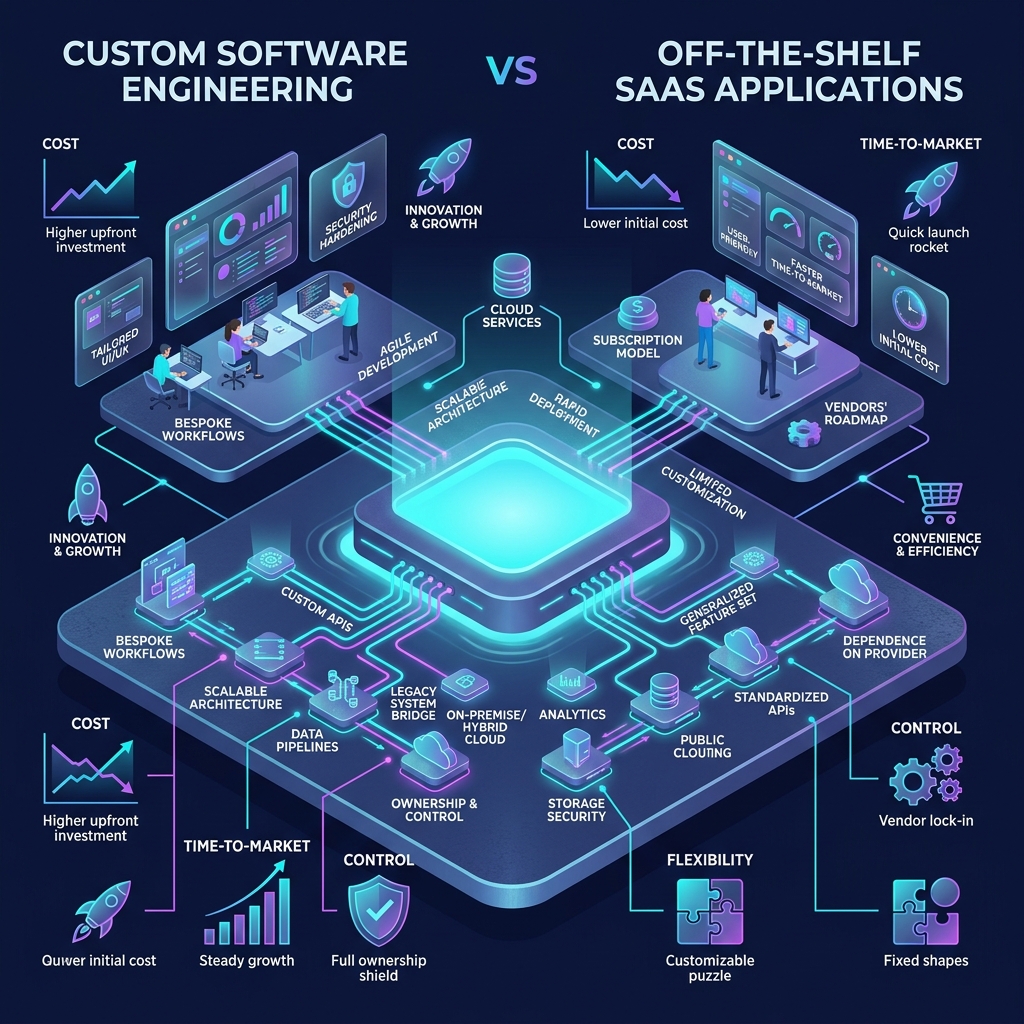
The SaaS Trap: Why Off-the-Shelf Seems Cheaper (Until It Isn't)
When a SaaS product costs $99 per user per month, a $150,000 custom software build sounds absurd. But you need to calculate the Total Cost of Ownership (TCO).
As your company scales, spreadsheets multiply, and your off-the-shelf tools stop talking to each other. You end up hiring administrative staff just to move data between systems. The true cost of generic SaaS includes the subscription fees, the expensive integration platforms (like Zapier), and the massive hidden cost of your team's wasted time doing manual ops work.
Building proprietary business software captures your unique process and turns it into a competitive moat. If you're struggling to choose between building and buying, read our breakdown on custom software vs. off-the-shelf: how growing companies decide.
Stop Managing from Six Tabs
Your edge is not in a tool everyone else can buy. If your team is busy maintaining tools instead of running the business, it's time to build a system that works the way you do.
We don't do year-long rebuilds in isolation. We start by mapping your workflows to find the friction, and we ship solutions in small increments.
Ready to replace manual work with an operating system your team trusts? Let's talk about your workflows.
FAQ
Frequently Asked Questions

Know a business that’s struggling to keep up with changing customer expectations?
Share this article.
Tell Us What You’re Seeing
How are customer expectations changing in your industry? Share your thoughts privately with Delta Insights.